

Personal Strategy
by Mingyue Zhu
21 April 2022
Introduction
My name is Mingyue Zhu, and I am a graduating student. My major is marketing in business administration, and my minor is in psychology. My previous internship experiences include Wayfair and Shanghai Media Group. At Wayfair, I served as a merchandising co-op, and my major responsibility was to leverage data and think of ways to enhance the customers’ shopping experience. At SMG, I had multiple roles. I coordinated with different teams on video projects, and I also trained and allocated work to new members. Unlike many students in my university who plan to get employed right after graduation, I intend to pursue a master’s degree. Therefore, my strategic challenge at front is to decide which programs to apply to.
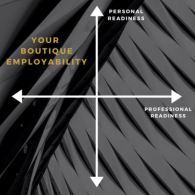
The Boutique Employability assessment (Exhibit 1) suggests that I am at a higher level of personal readiness, but at a lower level on professional readiness. I think this assessment evaluates me fairly. As a graduating student who has several internship experiences, I have now carried with me a prepared mindset for professional work. However, internships are unlike full time jobs in areas such as expectations and task complexities; that is the reason why I fall on a lower spectrum of professional readiness. I need to keep investing in my social trust as well as professional values to improve and become more prepared in a professional setting.
Exhibit 1: Boutique Employability E-test result from BE-EDGE
The BE-EDGE report (Exhibit 2) indicates that I am an EDGE-focused. I have a strong sense of self. I am willing to take charge of my own decisions while also embrace different possibilities, and I am not afraid to challenge the status quo to find new opportunities, instead of
acting in accordance with the conventions. I consider the result to be an accurate description since I am a person who do not take things as they are. I love to explore around and introspect afterwards, constantly asking “why” and “how”.
Exhibit 2: Personal Strategy E-test results from BE-EDGE
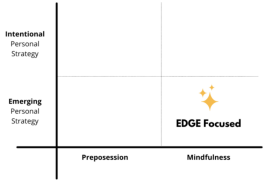
The BE test report reveals that my personal strategy is emerging. This strategy allows my own desires to drive my career decisions as well as personal choices. I usually start from the inner contexts, asking myself “what do I want”. This internal drive becomes my strength as it makes my professional profile multidimensional. However, when working with cross-functional teams, I do not draw all the attention to myself. Instead, I prefer to hear different voices and learn multiple perspectives, and I believe that my ability to look at issues from a holistic perspective will allow me and my team to come up with more innovative solutions. I am a good communicator; hence, I will be able to facilitate a welcoming and inclusive environment to best address the interest of various parties. Nevertheless, my multidimensional profile can also be a drawback if I lose my focus on where my career choices are taking me. Some people may perceive me as “all over the place”. For example, my major and minor seem unrelated—one is in business and the other in social science—which potentially may confuse others about what I am truly good at and passion for. My strong sense of internal self may blind me from the external environment; this is detrimental, as a result, I must improve my mindfulness to inspect the outer environment to find matches to my internal strengths. Exhibit 3 describes my self-perception of where my strategic leadership skills fall on a scale of 1-10, with 1 meaning underdeveloped and 10 meaning fully developed).
Exhibit 3: Strategic Leadership Traits: Personal Evaluation
| Strategic Leadership Traits | 1-10 |
| Vision, commitment to the vision, consistency | 6 |
| Enabling organizational competitive advantage | 3 |
| Being well informed | 8 |
| Pursuing an organization’s goals | 7 |
| Directing the activities of others | 5 |
| Successful use of power and influence | 6 |
| Willingness to delegate and empower | 6 |
There are also downsides of my traits that bring me cognitive biases, which I rated them in Exhibit 4 on a scale of 1-10, with 1 being rarely present and 10 being regularly present. I believe I mostly fall into the cognitive bias of escalation of commitment. When I feel passionate about a project, I am willing to devote my entire effort into it, thus mistaking the warning flag as a negligible error and making more attempts trying to correct it. This bias can be serious when I am deciding which programs to apply to, since it will lead to a waste of my time and resources. I will learn to overcome this cognitive bias by taking pauses every once in a while, to interpret the situation before making the next move. I am optimistic that I will learn to shift away from this bias gradually. The other bias that has a score over 5 (I consider 5 as a breakpoint) is illusion of control. I consider this bias arises less and less frequently as my mindset keeps expanding when I grow up. I believe this cognitive bias will keep diminishing, but it may not disappear completely since sometimes emotions drive me to act irrationally.
Exhibit 4: Cognitive Biases: Personal Evaluation
| Cognitive Biases | 1-10 |
| Prior hypothesis bias | 4 |
| Reasoning by analogy | 2 |
| Representatives | 2 |
| Escalation of commitment | 8 |
| Illusion of control | 6 |
Define
Challenge: After I graduate, I will go on and pursue my master’s degree. I need to leverage and align my competitive advantage with my career interest to decide which program(s) to apply for, so that I will have a better chance to get a job in the U.S. or U.K.
Stakeholders:
- Myself
I am the most instrumental stakeholder. Achieving my goals is not an easy task, but I need to have confidence in myself to overcome the challenges step by step and not give up. When I feel stressed, I can always reach out to my friends and my family to
regain energy. Most importantly, I must continue the habit of self-examination so I can have a clear picture of my current position and make decision on my next move.
- My family
My family supports me from every aspect; thus, they expect me to make the best use of my time and resources. They want me to succeed, but they also worry that I stress myself too much. The need for each other is mutual, and I would continue to contact them frequently as I do right now.
- The universities I will apply to (graduate admissions):
Competition has become more and more intense, and the universities are raising their standard for admission. The universities expect me to have at least basic knowledge and passion for the programs I apply for, and I shall prove my worthiness to study in the top programs.
- My future professors:
I need to show passion and willingness to learn. Since I may not be applying to the same subject I had as my major, it is likely that I will lack knowledge in some areas, and my professors would expect me to ask questions and challenge the concepts/theories so I can learn better. I should always be prepared for the classes and complete assignments on time with good quality.
- My future classmates in graduate school:
My classmates will be coming from a mix of backgrounds, which means we will hold dissimilar opinions on issues, and I must respect their voices. During classes, especially in team projects, I shall make efficient contributions and share my ideas. However, developing personal connections with my peers is as important, and I can do so by hanging out with them outside of the classroom.
- My future manager(s):
Since I already have co-op and internship experiences, my managers will expect me to know how to act appropriately and have a positive working attitude. However, I will still be considered a novice, and my manager(s) would not expect me to know everything smoothly when I first started. They will be expecting questions from me and will be willing to assist, so I shall not be afraid to ask for clarification.
Exhibit 5: Stakeholder Assessment
| Stakeholders | Expectations | Boundaries |
| Myself | -Undertake academic and
professional challenges |
-Do not stay up late
-Eat healthy |
|
-Create and maintain relationships -Grow and learn -Constant self-reflection |
-Quit/eat less snacks and desserts | |
| My family |
-Make best use of my resources -Maintain good physical and mental health |
-Contact them frequently
-Video chat once in a while -Go back home during breaks |
| Graduate admissions |
-Have foundational knowledge in the subject fields -Demonstrate interest in the field I pursue |
-Good communication skills -Able to pay the tuition |
| Future professors |
-Show passion and willingness to learn -Always ask/challenge the course material |
-Prepare for the classes
-Complete assignments in good quality |
| Future classmates |
-Respect everyone -Be open to different ideas |
-Be friendly and helpful, both academically and in spare time |
| Future managers |
-Have sufficient knowledge and skills -Make effective contributions -Take initiative on projects |
-Arrive work on time
-Always communicate |
Vision: I envision myself at the welcoming event at school in London. The room is full of unfamiliar faces: professors and new students. I overcome the nervous feeling and approach a group of students; we introduce ourselves and exchange contact information. Getting connected with new people makes me look forward more to the new semester and prospect opportunities.
Professional Core: I will first do an analysis on my ability to find out my strengths and weaknesses to understand what knowledge and skills I currently lack. I will then investigate the programs that different universities offer and determine which ones I will apply to. I am mainly doing this to enhance myself, so that I will have a more competitive advantage in the job market. I will be able to make more contributions for my future company to make my company outcompete the others.
Mission: I will go to graduate school to enhance my knowledge in business-related subjects to complement my competitive advantage. In this way, I can stand a better chance to get a job in the U.K. and/or U.S.
Desired Strategy-Making Process: According to the BE test, my desired strategy-making process is emergent. I will take gradual steps to learn about myself, the career I want to pursue, and the programs that will fit me.
Analyze
I began to conduct an internal analysis to find my strengths by using the VRIO and Value Chain framework (see Exhibit 6 and Exhibit 7). The resources and capabilities that will best help me to stand out are from the “costly to imitate” category. I do not possess a lot of them at the moment, but I can build them through primary and support activities. However, I can still make good use of my other resources and capabilities. I can utilize my networking skills and personal relationships to connect with more people, asking for their advice and opinions, so I can alter my short-term plans to best lead in reaching my long-term goal. In the short term, I decide to pursue a master’s degree in the UK. The competition for graduate school has become more intense, and I need to enhance my hardware. On behalf of academics, I must not relax for the last semester; I need to keep up with my grades and hopefully finish with a higher GPA than my previous terms. What’s more, since I am most likely to apply in the subject of business, I have to study the GMAT materials for a better score. Personal statements and interviews are critical too, hence, it is necessary for me to practice my writing and interview abilities. In order to fulfill my long-term goal, which is to work in the UK or the US, keeping up with support activities are essential as well. For instance, making good connections with my peers, professors, and managers is not only for the purpose on a career level, but having them as my friends will make my life happier since I am a person who relies on support from friends. Likewise, paying attention to job opportunities may allow me to discover unexpected circumstances; who knows what will happen?
Exhibit 6: VRIO Framework
| Resources & Capabilities | Valuable | Rare |
Costly to Imitate |
Organized to Capture Value |
| Undergraduate degree from a university in the U.S. |
Y |
Y |
Y |
Y |
| Fairly good GPA |
Y |
Y |
N |
Y |
| Sufficient knowledge in business related subjects |
Y |
N |
N |
Y |
| Marketing major and psychology minor |
Y |
N |
N |
Y |
| Internship experience in both analysis and advertising aspects of marketing |
Y |
Y |
Y |
Y |
| Bilingual |
Y |
N |
N |
N |
| Strong execution ability |
Y |
Y |
N |
Y |
| Good communication skill |
Y |
N |
Y |
Y |
| Good presentation skill |
Y |
N |
Y |
Y |
| Friends in different industries |
Y |
N |
N |
N |
| Supportive family |
Y |
Y |
Y |
Y |
Exhibit 7: Value Chain Framework
|
Primary Activities |
-Keep up with academic work to have a better GPA -Research on the expectations of job field I am interested in -Look up the entry requirements and course structure for different programs -Get more internship experiences in related field -Study the GMAT materials to get a higher score -Practice interview techniques |
|
Support Activities |
-Analyze my strengths and weakness -Find out the skills I need to enhance -Synchronize my passion and ability to find a focus -Make good connections with professors and managers -Subscribe to the institutions for updates on their offered programs -Be attentive to network opportunities -Find a reliable agency to polish my personal statement -Network with peers, alumnus, professors, and managers -Take advantage of school’s career resources |
I intend to work in the entertainment industry in London. The major reason for me to choose London is that it is an international city full of arts and creativity. The city has many positives as well as negatives as listed in the PESTEL framework (Exhibit 8). The positive sides that attract me the most are that the city consists of a diverse population, the transportation is convenient, and the recreational life and activities are rich. However, I recognize that there are also downsides that need to be taken into consideration. One of the issues that is inevitable to think about is the economy since it affects my daily life. Since inflation drives up prices, it is necessary for me to ensure I can earn enough wage to compensate for my expenses.
Exhibit 8: PESTEL Framework – External Market: London
|
Opportunities |
Threats |
|
| Political |
-The UK maintains good relations with many countries (David, 2022) -Stable government (Shaw) |
-Recent rise in violence and crimes (David, 2022) -Some companies are still uncertain about the Brexit deals |
| Economic |
-Economy recovered to almost pre COVID level (Jolly, 2022) -Economy grows 0.8% in January, which is more than expected (Bruce and Milliken, 2022) |
-Soaring inflations (Bruce and Milliken, 2022) -Negative impacts result from Ukraine War (Bruce and Milliken, 2022) -Recession risk (Bruce and Milliken, 2022) |
| Sociocultural |
-Population is multicultural (David, 2022) -Increased level of education and change in lifestyle affect consumer preference -Rich recreational activities such as Broadway shows |
-The costs of living and higher education are on the rise (David, 2022) -Competition for graduate jobs is intense |
| Technological |
-London is a great hub for financial and technological institutions (David, 2022) -Email makes it quicker to communicate -Interview can be conducted any time -Underground in London is quick and accessible |
-UK is falling falls behind the USA and some other countries in technological development (David, 2022) -Email may not be as efficient as in person -Video based interview may hinder performance: no actual interviewer communicates with the interviewee |
| Ecological |
-Governments have taken initiative to reduce negative impact of economic growth on environment (David, 2022) |
-Challenging weather conditions (David, 2022) |
| Legal |
-The Employment Act 1996 protects rights of employees (David) -The Equality Act 2010 protects people from discrimination (David) |
-Must find a company that is willing to provide work visa in UK |
I analyzed the profit potential of media and entertainment industry by using Porter’s Five Forces framework (Exhibit 9). In general, I believe that the competition in media and entertainment industry is somewhat intense but not in a negative way.
Exhibit 9: Porter’s Five Forces: Media and Entertainment industry
| Threat of entry
Low |
High barrier to entry: established companies with significant presence occupy the industry (Abercrombie et al., 2011) -Hard for new companies to get their products into the market |
| Power of suppliers Moderate | -Seasonal campaigns differ in supply demands (Loganathan, 2013) -Suppliers are industry independent (Loganathan, 2013) -Multi-year/multi-movie contracts reduce suppliers’ bargaining power
-Can forward integrate -Premium ad spaces are limited but demand is high |
| Power of buyers
High |
-Difficult to backward integrate for buyers |
| -Identity of buyer add prestige to sellers’ list of customers (Loganathan, 2013)
-Large buyers can demand concessions (Loganathan, 2013) -Consumers have a wide selection of sources of entertainment (Abercrombie et al., 2011) |
|
| Threat of substitutes
Low |
-Constant evolution of technology offer new channels for forward integration (Loganathan, 2013) |
| Rivalry among
existing competitors High |
-High stakes with campaigns build credibility (Loganathan) -High premium on scarce resources (Loganathan)
-Increase competition among entertainment delivery platforms (Abercrombie et al., 2011) |
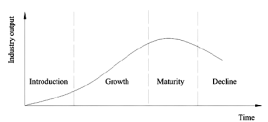
The industry lifecycle of entertainment industry is at the growth stage (shown in Exhibit 10). This industry has encountered technological progress, changing generational behaviors, and impacts due to the pandemic; as a result, it continues to evolve and response to these changes. During pandemic, people have discouraged to go to large in-person events; as a result, they have begun to seek entertainment and media at home. The already trending digital media industry has been accelerated in year 2021. The broader socioeconomic dynamics appear to be converging with technology and amplifying changes. To businesses in the media and entertainment industry, this means potential opportunities include but not limited maturing streaming video industry, more complicated demands for in-person entertainment, and the expansion in social media applications.
Exhibit 10: Industry Lifecycle: Media and Entertainment Industry
After conducting the internal and external analysis, I organized into a SWOT table (Exhibit 11). I find that while I have weaknesses and face many threats, I still have opportunities to build on my strength to expand my competitive advantage.
I identified some matches between my strengths and opportunities and put them in the same color. My plan is to take gradual steps, to first attend graduate school in London, and then look for job opportunities in the U.K. or the U.S. First and foremost, I need to make a decision on which programs to apply to. My major and minor in my undergraduate school is marketing and psychology; since I aim to work in the entertainment industry, it will be helpful for me to apply to communication/media programs.
However, it is also reasonable for me to apply to programs in social science so I can understand my audiences better. Having a clear direction of my career path but not limiting myself to a specific position allows me to be flexible with my application personal statements. For whatever business-related program I apply to, I will have the ability to articulate and demonstrate my passion; therefore, having an agency (my friend or someone who has good writing skills) to polish my personal statements will be like putting icing on the cake. Another important process during admission is the interview.
Since I did many projects and enjoyed my previous co-op and internships, I will have plenty to talk about for the admission interview. Besides, the interview skills I learned at Northeastern will better prepare me for both an admission interview and job in the future. During my time at graduate school, I need to keep networking with my peers and professors, not only to enrich my life at school but also to expand my connection. Knowing like minded people is more likely to help me to connect with those who work in my interested industries, and this is very critical to my career development.
Exhibit 11: SWOT Analysis
| Strength | Opportunities |
| -Graduate with a degree from university in the U.S.
–Have a clear direction of my career path -Internship experiences in advertising and media industry -Internship experience in e-commerce industry -Marketing and psychology knowledge -Understand different practices in western and eastern culture |
-Find agency to polish my personal statement
-Submit the applications early -Practice my interview skills -Actively look for recruitment information –Network with people in the field -Take classes in advertising/media field -Go to career center regularly -U.K. released new visa policy (Global Talent) |
| Weakness | Threats |
| -GMAT score is not high enough
-Lack of quant knowledge -Hard to make decisions -Lack of professional trainings in media production -I am a foreigner to U.K. and U.S. |
-Some applicants have more professional work experiences
-Competition for graduate school has intensified -London is an art hub that has many students graduating in art degree |
Formulate
According to the analysis, I generate several ideas and rate them according to my stakeholder’s expectations in Exhibit 12. The rating scale is from 1 to 5, with 5 being most interested and 1 being least interested.
Idea #1: Decide on subject(s) and program(s) of my interest and can help advance my career.
Idea #2: Find a reliable agency to evaluate and polish my admission personal statement
Idea #3: Practice my interview skill: how to appropriately answer behavioral questions, how to present myself and demonstrate my passion.
Idea #4: Socialize and network: connect with my peers and professors for personal life as well as for possible future references.
Exhibit 12: Stakeholders’ Expectations Evaluation
|
Stakeholder’s expectation (1-5) |
|||||||
| Myself | My family | Universities (admission) | Future
professors |
Future
classmates |
Future
managers |
Total | |
| Idea 1 |
5 |
3 |
5 |
5 |
4 | 4 |
26 |
| Idea 2 |
4 |
3 | 4 | 1 | 1 | 1 | 15 |
| Idea 3 |
4 |
3 |
4 | 4 | 3 |
4 |
22 |
| Idea 4 | 5 | 4 | 3 | 5 | 5 | 5 |
29 |
According to Exhibit 12, the two ideas that have the highest scores are idea #1 and idea #4, which idea #1 is a short-term action and idea #4 is the action needed in the long-run. As of the first step, it is necessary for me to look up and decide on the programs that I am interested in and that fits my background. This decision is going to have a long-term impact especially on the stakeholders that I identified as the “future” ones: the people I will meet, the subject(s) I will learn about, and maybe even the job I will work on. Apart from the foremost action, I need to bear in my mind the significance of my relationships. Getting in touch with people for me does not only mean to take advantage of their resources, but more importantly, I am a person who draw happiness from friends. I understand that professors and managers are not the casual “friends” I have but maintain a good relationship with them does no harm to me. Not only will I able to learn from them, but they may also assist me to connect with the “right” people.
Value Proposition
My value proposition is that I am a multidimensional talent who has knowledge and experiences in subject areas including media, marketing, and psychology. I am not afraid to speak up and share my ideas and contribute to my teams in both academic and working settings. On top of that, I always ensure the communication between each stakeholder is clear, so that the cooperation will be effective, and the outcome will be high in quality.
Positioning Strategy
Exhibit 13: Personal Business Model Canvas
| Key Partners -Parents
-Friends -Agency -Professors -Managers |
Key Activities
-Research & apply (graduate programs and job positions) -Interview -Communicate -Connections |
Value Propositions -Clear
communication -Quality performance -Constructive inputs |
Customer
Relationships -Take initiative -On demand |
Customer
Segments -Admission teams -Marketing professionals -Entertainment consumers -Advice-seeker |
|
| Key Resources
-Work experiences -Network -Communication skills -Cross culture mindset |
Channels
-Interview -Career fair -Phone call |
||||
| Cost Structures
-Innovative ideas -Unique perspective -Presentations -Data analysis -Project management |
Revenue Streams
-Offer(s) -Wage -Feedbacks -Connections |
||||
Competitive Strategy
My competitive strategy will be differentiation. To compete in a western job market, my eastern culture background adds value as I have a good understanding of the different practices in both cultures, but this is not enough. Some of the key resources that will make me stand out, besides the internship experiences, are my knowledge in different subject fields. Besides having a business major, I also take classes in psychology for my minor. What this translates into is that I have a keen insight to interpret problems from a behavioral aspect in addition to the business lens. In addition, I hope the master’s degree I will be pursuing will be a complement to my competitive advantage.
Extension (global) Strategy
For my future extension, the U.K. and the U.S. are the markets I am most interested in, therefore, I conducted a CAGE analysis for both countries (see Exhibit 14). The U.K. market is already a foreign one to me, and since the cultural distance between the two markets is low, I do not think it is necessary for me to change the positioning strategy. Instead, I will keep expanding my resources and competencies so I will be more flexible with abilities to differentiate myself from the rest of my competitors. The entry mode I plan to use is localization, as it will be most likely for me to work in cross-functional teams, and local responsiveness is essential.
Exhibit 14: CAGE Framework: U.K. and U.S.
|
CAGE |
UK |
US |
|
Cultural |
-Diverse culture -Hub of arts and literature -Enjoy social interaction relating to popular culture |
-Diverse culture
-Leader in mass media production -Sports-minded country (Zimmermann, McKelvie) |
|
Administrative & Political |
-Administrative divisions: England, Scotland, Wales, Northern Ireland -Different structures in each
constituent country (Administrative geography) |
-Stable political climate
-Fair electoral process |
|
Geographical |
-Transportation (underground) is convenient in London
-There are trains connecting to surrounding cities |
-Usually need cars
-Transportation is convenient only in big cities like NY or Boston |
|
Economic |
-COVID spending helps economy to grow (Jolly)
-Firms face high inflation pressure -Trade hit from Brexit |
-Largest economy in the world -Strong job growth
-High inflation |
Growth & Sustainability Strategy
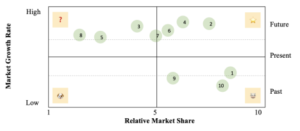
I organized my skills and competencies in terms of market share and market growth rate into the BCG Matrix. The skills and competencies that fall in the star quadrant are the ones that need my constant investment, most likely through practicing consistently. The three skills fall in the cash cow quadrant, I can leave them as they are and use them as my side job occasionally. The competencies in the question mark quadrant are the most urgent ones for me to enhance. I consider the Excel skill to be the most critical one, since proficiency in Excel is an entry requirement for most of the business jobs nowadays; I plan to take online Excel classes first, and if I am able to, I will find practice trials to do exercises. The ability to edit video and make creative designs are desired skills but may not be a solid requirement, hence, I will consider taking classes if there is a chance, but otherwise I do not need to worry about these skills too much.
Exhibit 15: BCG Matrix
| Skills & Competencies | How Good (1-10) | Past, Present, or Future |
| 1. Bilingual: able to translate |
8 |
PP |
| 2. Make presentation |
7 |
PPF |
| 3. Use Excel to do analysis |
4 |
Present, Future |
| 4. Make connections with people |
6 |
PPF |
| 5. Edit Videos | 3 | Present, Future |
| 6. Organize, plan, and prioritize work | 6 | PPF |
| 7. Social Media management | 5 | Present, Future |
| 8. Creative design | 2 | Future |
| 9. Write and edit papers | 6 | PP |
| 10. Take care of kids | 8 | Past |
Implement
My BE results indicate that my personal strategy is emergent, and I decide to stay with this strategy. I believe that plans cannot keep up with the changes, so it is best for me to take one step at a time to approach my goal. My long-term goal right now is to work in London; however, it will be a challenging task for me since I am a foreigner to the country, and intentional strategy would not be practical in this case. In order to achieve the goal, my short-term plan is to apply to and get enrolled in a graduate program in the university in the U.K. to build on competencies. In addition, I will be able to utilize the resources from the school to apply for job positions since the school obtains local resources.
As a newcomer to the school, and later the work group, I will face some social challenges. While at school, my top priority is to develop a good relationship with my professors, and they are more likely to be convinced by my academic performance. I am less worried about my peers because I will have the chance to interact with them frequently both in class and after class. As I enter the workplace, the first person I need to connect is my manager. The best way to prove myself is through the quality performance on the assigned projects, however, casual chats can also help me build a good relationship with my manager. Establishing relationships with colleagues are easier and more casual but swaying a team leader will need consistent effort to
demonstrate my abilities. In Exhibit 16, I depict the relevant parties who I will encounter and the ways I will approach and develop relationships with them.
Exhibit 16: Social Functional Strategy
| Actor
(individuals or groups) |
Would/should | Data-driven/ people-driven | Your Action | Priority (1,2,3) | |
| Short-term | Peers | Would | People-driven | Recreational activity, study group | 2 |
| Professors | Should | Data-driven | In-class & assignment performance | 1 | |
| Long-term | Colleagues | Would | People-driven | Coffee chat | 3 |
| Manager | Should | Data-driven | Project, coffee chat | 1 | |
| Team leader | Would | Data-driven | Team meeting
contributions |
2 |
To deal with the challenges, I can prove my preparedness via different projects. Exhibit 17 lists the projects I can participate in to showcase my abilities. While at graduate school, I can volunteer to become a teacher’s assistant. In this way, I can not only demonstrate my competence, but also get to know more people. Besides, I will stay close to people from my culture. We will celebrate holidays in our culture, but I think it will be a good idea for us to hold events and invite students from different backgrounds to engage and learn about our culture. After I graduate and enter the workspace, I will take other approaches to present my skills. Since I have experience in data analysis, I can conduct similar tasks to identify consumer pain points and address the problems through content optimization. This project will indicate my specialized skills to enhance customer experience and drive growth for the company. Apart from the data aspect, I am also good at making presentations. Therefore, I can volunteer to create a project roadmap presentation and/or year-end summary presentation to show my multidimensional skills. This project will require me to do some research, which in turn will expand my field knowledge; what’s more, I will also have the opportunity to know my team and my company better.
Exhibit 17: Operational Functional Strategy
| Opportunity to sign
in/volunteer |
Project/ problem | Specialized/Multi dimensional | Priority to match my strategy | My Action |
| Sign-in | Teacher’s assistant | Specialized | High | Hold TA Q&A sessions, Zoom meeting
appointments |
| Volunteer | Plan culture
activities |
Multidimensional | Medium | Culture shows, movies, holiday celebration
parties |
| Sign-in | Customer
experience enhancement |
Specialized | High | Retrieve data, use tools to analyze, come up with
ideas |
| Volunteer | Project roadmap presentation | Multidimensional | Medium | Gather
information, research |
The most important strategic stakeholder currently is my family. My family expects me to return home to work when I graduate, but I decided to go to a graduate school first and find a job in London. The change strategy I choose to take is force-coercion, since it is the most straight-forward action. The initial reaction of my family may be shocking. However, I will tell them my reasons by analyzing the pros and cons; in this way, they will take my words into consideration. My family is very liberal and supportive, hopefully it will not take them long to accept my change of plan. I have made a list of the action plans (Exhibit 18) I intend to take with a timeframe in the path of my own vision.
Exhibit 18: Action Plan
| Strategy | Action Plan (How) | Timing-Completion Date | Person Responsible |
| Decide which
program(s) to apply |
Research online | June 2022 | Myself |
| Request for letter of recommendation | Email professor(s) and/or previous manager(s) | September 2022 | Myself,
professor(s), manager(s) |
| Finish Personal
Statement(s) |
Write about my strengths and passion, and ask
agency to help polish |
October 2022 | Myself, agency |
| Submit applications | Submit all the required materials to the school(s) | November 2022 | Myself |
| Prepare for
interview |
Practice STAR method for behavioral questions,
review my resume and program structures |
December 2022 | Myself, interviewer |
| Enroll in the school | Get the visa, submit
required documents |
August 2023 | Myself |
The expected cash flow statement I made in Exhibit 19 is for the six months following graduation. I will not begin working immediately, and my parents will be my main financial supporter. Since I do not make my own income, I will try my best to save some money every month. Spending such as rent, utilities, and transportation are fixed, but I can cut down money spent on groceries and recreational activities; for example, I can prepare meals more frequently instead of dining outside. If there comes any opportunity, I can always get a part-time job and make some money on my own.
Exhibit 19: Expected Cash Flow Statement
| May | June | July | August | September | October | |
| Cash on hand | $710 | $1,010 | $860 | $1,010 | $1,010 | $1,010 |
| Income | $4,700 | $3,500 | $3,500 | $3,500 | $3,500 | $3,500 |
| Expenses | ($3,990) | ($2,490) | ($2,640) | ($2,490) | ($2,490) | ($2,490) |
| Rent | $2500 | $1800 | $1800 | $1800 | $1800 | $1800 |
| Utilities | $70 | $70 | $70 | $70 | $70 | $70 |
| Groceries | $300 | $300 | $300 | $300 | $300 | $300 |
| Transportation | $120 | $120 | $120 | $120 | $120 | $120 |
| Recreational
Activities |
$1,000 | $200 | $350 | $200 | $200 | $200 |
References
Bruce, Andy. Milliken, David. UK economy surges unexpectedly, bolstering case for rate hike next week. Reuters. March 11th, 2022. https://www.reuters.com/world/uk/uk-economy rebounds-strongly-january-ons-2022-03-11/
Jolly Jasper, Covid spending fuelled faster growth in UK economy in late 2021, ONS says. The Guardian. March 31st, 2022. https://www.theguardian.com/business/2022/mar/31/uk economy-growing-faster-than-thought-ons-says
David, Joe. PESTEL analysis of the UK. Howandwhat. March 22nd, 2022. https://howandwhat.net/pestel-analysis-uk/
Shaw, Absan Ali. PESTLE Analysis of UK. https://www.marketingtutor.net/pestle-analysis-of uk/
Loganathan, Pradeep. Porters Five forces for Advertising and Branding Industry. February 13th, 2013. https://www.slideshare.net/pradeep_loganathan/porters-five-forces-for-advertising and-branding-industry
Abercrombie, Nicole. Austin, Rachel. Elia, Jessica. Reed, Jessica. Torres, Jenni. Entertainment Industry Analysis. May 13th, 2011.
https://www.csus.edu/indiv/h/hattonl/documents/entertainmentindustryanalysis.docx Jolly, Jasper. Covid spending fuelled faster growth in UK economy in late 2021, ONS says. The Guardian. March 31st, 2022. https://www.theguardian.com/business/2022/mar/31/uk economy-growing-faster-than-thought-ons-says
Administrative geography. https://www.ons.gov.uk/methodology/geography/ukgeographies/ administrativegeography
Zimmermann, Kim Ann. McKelvie, Callum. American Culture: Traditions and Customs of the United States. LiveScience. December 21, 2021. https://www.livescience.com/28945- american-culture.html
